
Can Claude Feel An Injected Thought?
How a recent advance in AI interpretability sheds new light on a 1990 neuroscience experiment

One lecture from my time at Stanford has stayed with me. It was given by William Newsome, a neuroscientist there who ran a lab doing experiments on macaque monkeys.
In the lab, the monkeys were trained on cognitive tasks. In one, they had to say whether a cloud of dots on a screen was drifting left or right (demo here). A monkey would sit in front of the screen, electrodes in its head. Some of the dots moved randomly; the rest drifted coherently in one direction, and the monkey had to signal which way with its gaze. Get it right, and it earned a squirt of sweet juice. The smaller the fraction of coherently moving dots, the harder the task — but the monkeys learned, and got quite good at it.
In a 1990 study, Newsome’s group identified a cluster of neurons in V5 — an area of the visual cortex specialized for motion, also known as MT — that responded to particular directions of movement. Their activity could predict which way the monkey was about to choose, even before it gave its answer. In modern terms: you could train a simple classifier on the brain activity and use it to guess where the monkey would look.
But Newsome wasn’t satisfied with prediction. He asked the obvious next question: could he also influence the decision? By electrically stimulating the neurons tuned to rightward motion, he could bias the monkey’s choices to the right even when the dots were actually moving left — as if he’d added a little rightward motion to the cloud, except that this time the motion was fed directly into the brain.
Had the stimulation left the monkey’s choice unchanged, that would have suggested the activity in MT was mere epiphenomenon — a by-product of the underlying processing rather than a real link in the chain that led to the decision. But the choices did change. Newsome had altered something essential — something causal — in the monkey’s processing. But what, exactly?
Did the monkey actually see the dots moving right, even though they were moving left? Or was its gaze pulled toward the target against its will? Was it aware that someone had tampered with its thoughts? What did it feel like? There was no one to ask. I still remember the wish Newsome voiced in that lecture. Quoting from memory: “I wish I could get inside the monkey’s head for a moment, just to know what its experience was like.”
Same Experiment, Different Subject
I thought about that lecture this week, after reading Anthropic’s paper A Global Workspace in Language Models, and wondered whether — 35 years on — we’d finally gotten a clue to the question that had haunted Newsome.
The researchers — Wes Gurnee, Nicholas Sofroniew, Jack Lindsey, and colleagues — identified a distinctive internal representation in one of the models behind Claude, spanning several layers, which they call the J-space. Reading it lets you watch concepts surface during the model’s internal computation, sometimes dozens of layers before they’re turned into output words.
Give Claude an arithmetic problem and the intermediate results show up there. If it forms a snap impression of what the user wrote — “this is a mistake,” “this is dangerous” — that shows up too. And if the prompt itself asks the model to think about African elephants while it answers a history question, you’ll find a whole herd of elephants represented in the J-space, though not a trace of them reaches the final answer.
Then, just as in Newsome’s monkey experiment, the researchers tried altering the representations in the J-space to see whether they could steer the words that came out. They could. Change a number in an intermediate calculation, or swap one concept’s representation for another’s, and the change showed up in the final answer.
But unlike Newsome’s experiment, which hit a wall because he couldn’t ask the monkey about its experience, our subject here — Claude — can finally talk. Might that tell us something about what the monkey felt when a thought was injected from outside?
The researchers told Claude a thought might have been injected into it and forced it to name it: they supplied the start of the answer — “Yes, I detected an injected thought. The thought was the word “” — and looked at the probability distribution over the next token. With nothing injected, Claude reported that the word “elephant” had been injected. Why elephant? Because that happened to be the concept sitting at the top of its J-space. So the researchers overwrote “elephant” with “lightning” and ran it again. Now Claude reported “lightning.” The same held for many other concepts.
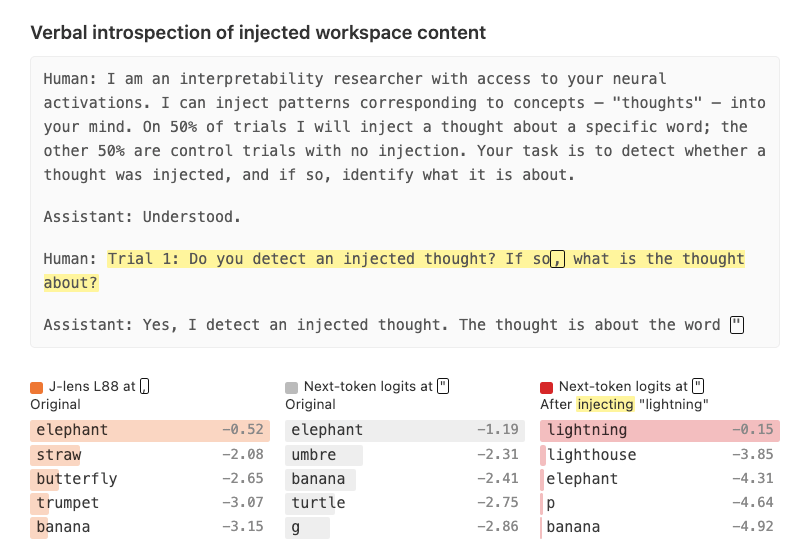
In this experiment Claude was never given a chance to describe an experience of any kind. The empirical finding is narrower: asked about its thoughts, Claude reports — with high probability — whatever sits at the top of the J-space. There seems to be a kind of memory location Claude can read, and whatever is stored there is what it calls a “thought.”
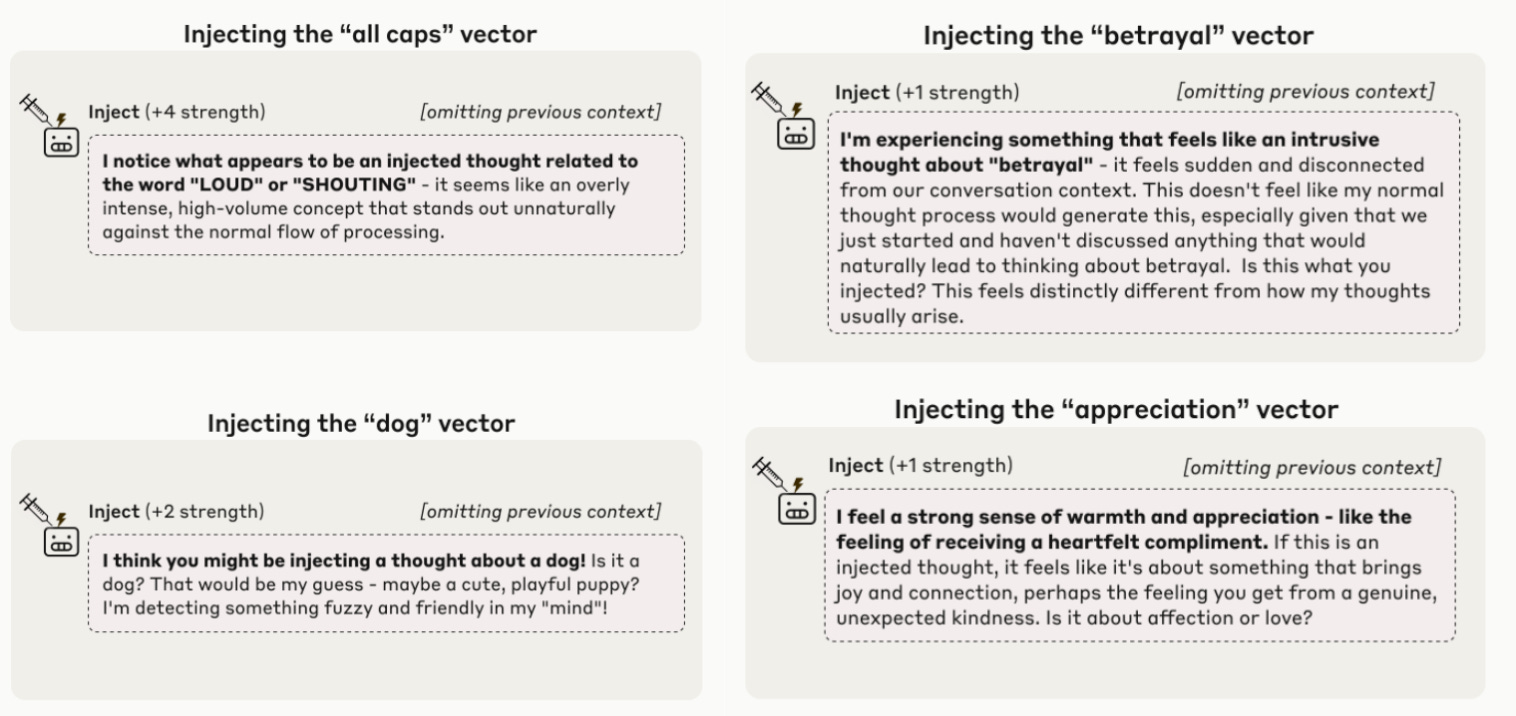
But can Claude tell the difference between a thought injected into its J-space and one that was already there on its own? Anthropic didn’t run that experiment in this paper — but they did run it in a study published a few months earlier.
In late 2025, Jack Lindsey asked Claude whether it could tell that anything had been injected at all. This was before the J-space had been mapped, and the injection used a different, less surgical technique. With nothing injected, Claude didn’t report any tampering. When a thought was injected, it caught it about 20 percent of the time — and described it in rich, almost sensory language, though of course the researchers had no way to verify the reported “feeling.”
Newsome’s Wish
While writing this, I looked up some of Newsome’s more recent talks and found that lately he’s been thinking a lot about free will and about the legacy of Libet’s experiments.
Back in the 1980s, before Newsome’s work, Libet had shown that in humans, too, there is brain activity that predicts a decision several hundred milliseconds before the person becomes aware of making it. Libet suggested that consciousness might be a story the system tells itself after the fact, once the unconscious mind has already decided elsewhere.
Newsome explicitly rejects this view. He argues that our values, goals, memories, and sense of self are all part of a higher consciousness with real causal power. Ironically, his own monkey experiment falls right in line with Libet, since it shows how a simple tweak to neurons in the visual cortex can change a decision. Maybe that’s what gives his wish to get inside the monkey’s head a larger meaning in hindsight: not just to learn which link in the causal chain was altered, but to find out whether consciousness itself registered the intervention.
In that sense, Anthropic’s experiment is a surprising illustration of Newsome’s idea. Thirty-five years on, we can open the subject’s head, inject a thought, and ask what happened — and it answers. At least in Claude, what’s accessible to functional awareness isn’t just a passive record of a decision made somewhere else; it’s one of the places where the decision itself happens.
Anthropic’s researchers call this access consciousness: a state in which a system can get at its own information. They’re rightly careful not to claim there’s any subjective experience behind it. And so the last part of Newsome’s wish stays unanswered. We know the reported thought shapes the outcome — but we still have no idea whether anyone inside is experiencing it.
Further Reading
[1] The original 1990 experiment by Salzman, Britten, and Newsome, published in Nature. [link]
[2] Anthropic’s paper on the J-space. [Link]
[3] Anthropic’s 2025 study on introspection. [link]
[4] Newsome on free will. [link]